

exportdefault {
returnnewResponse('Hello from Vercel!');
Build API routes, webhooks, and agent request handlers that scale with traffic. Test locally and trace deployed requests with Vercel CLI.
};
},
fetch(request:Request) {
When you deploy your application, Vercel automatically sets up the tools and optimizations for your chosen framework. It ensures low latency by routing traffic through Vercel's CDN, and placing your functions in a specific region when you need more control over data locality.
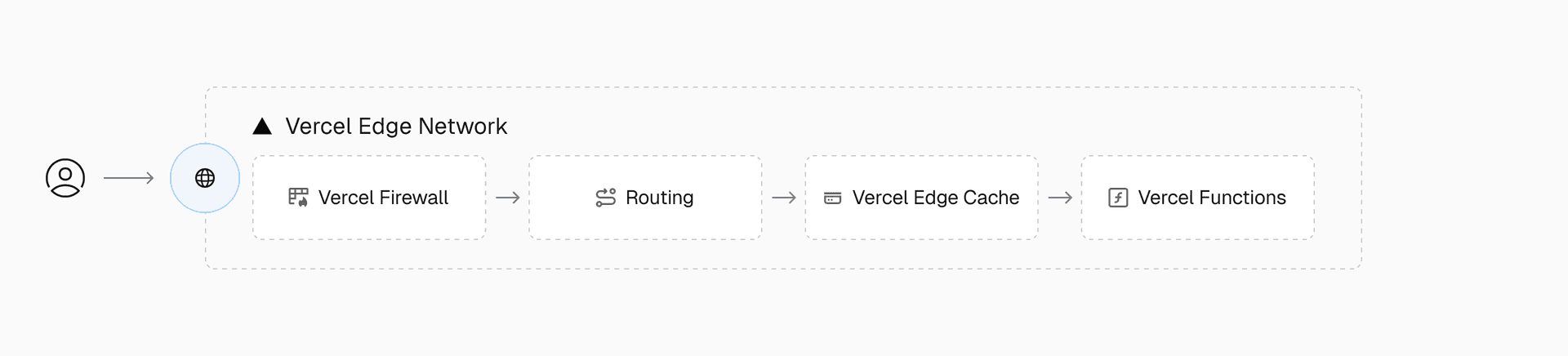
Functions location within Vercel's managed infrastructure
Build APIs and agent request handlers
Vercel Functions run request-driven API routes, webhooks, streamed model responses, and agent turns. Use Vercel Workflows or eve when an agent must preserve progress across pauses or deployments.
- Zero server management. Deploy code that scales automatically with traffic
- Fluid compute. Reduced cold starts, lower latency, and lower costs via optimized concurrency
- Multi-runtime support. Use Node.js, Python, Go, and more
- Regional control. Pin functions to a region close to your data source
- Framework-aware. Vercel detects and optimizes for your framework automatically
- Built-in observability. View invocations, errors, and cost metrics in the dashboard
Create your first Vercel Function
Copy the code below to create your first function:
To learn more, see the quickstart or deploy a template.
returnnewResponse('Hello from Vercel!');

exportfunctionGET(request:Request) {

returnnewResponse('Hello from Vercel!');
TypeScript

Next.js (/app)
How the Vercel Functions lifecycle works
Vercel Functions handle each incoming request as a new invocation, scaling automatically so you don't need to manage servers. They run in a single region by default, although you can configure them to run in multiple regions if you have globally replicated data. These functions let you add extra capabilities to your application, such as handling authentication, streaming data, or querying databases.
When a user sends a request to your site, Vercel can automatically run a function based on your application code. You don't need to manage servers or handle scaling.
Vercel creates a new function invocation for each incoming request. If another request arrives soon after the previous one, Vercel reuses the same function instance to optimize performance and cost efficiency. Over time, Vercel only keeps as many active functions as needed to handle your traffic. Vercel scales your functions down to zero when there are no incoming requests.
By allowing concurrent execution within the same instance (and so using idle time for compute), fluid compute reduces cold starts, lowers latency, and saves on compute costs. It also prevents the need to spin up multiple isolated instances when tasks spend most of their time waiting for external operations.
Functions should always execute close to where your data source is to reduce latency. By default, functions using the Node.js runtime execute in Washington, D.C., USA ( iad1), a common location for external data sources. You can set a new region through your project's settings on Vercel.
Viewing Vercel Function metrics
You can view various performance and cost efficiency metrics using Vercel Observability:
- Choose your project from the dashboard.
- Click on the Observability tab and select the Vercel Functions section.
- Click on the chevron icon to expand and see all charts.
You'll see current function usage metrics, including Active CPU, Provisioned Memory, Invocations, and savings from the optimized concurrency model when fluid compute is enabled.
How Vercel Functions pricing works
Vercel Functions are priced based on active CPU, provisioned memory, and invocations. See the fluid compute pricing documentation for more information.
If your project is not using fluid compute, see the legacy pricing documentation for Vercel Functions.
Explore Vercel Functions


Cross-link map: Vercel Functions (/docs/functions)From the Vercel docs graph (built 2026-09-21T05:26:59.511Z), spanning vercel.com docs + KB, nextjs.org, ai-sdk.dev, and other Vercel documentation sites. Full graph as JSON: https://vercel.com/docs/graph.jsonSemantically closest pagesUnderstanding Vercel FunctionsGetting started with Vercel Functions — Build your first Vercel Function in a few steps.Legacy Usage & Pricing for Functions — Learn about legacy usage and pricing for Vercel Functions.Evolving Vercel FunctionsHosting your API on Vercel — Learn how to build and scale performant APIs on Vercel.This page links to (18)route.js — API reference for the route.js special file.Vercel CDN overview — Vercel's CDN is a globally distributed platform that handles routing, caching, security, and compression for every deploeve — Build and deploy durable backend AI agents with eve, an open-source, filesystem-first framework.Fluid compute — Learn about fluid compute, an execution model for Vercel Functions that provides a more flexible and efficient way to ruFrameworks on Vercel — Vercel supports a wide range of the most popular frameworks, optimizing how your application builds and runs no matter wConfiguring Functions — Learn how to configure the runtime, region, maximum duration, and memory for Vercel Functions.Configuring regions for Vercel Functions — Learn how to configure regions for Vercel Functions.Debugging slow Vercel Functions — Diagnose and fix slow Vercel Functions using CLI tools, logs, and timing analysis.Functions API Reference — Learn about available APIs when working with Vercel Functions.Vercel Functions Limits — Learn about the limits and restrictions of using Vercel Functions.Vercel Function Logs — Use runtime logs to debug and monitor your Vercel Functions.Getting started with Vercel Functions — Build your first Vercel Function in a few steps.Runtimes — Runtimes transform your source code into Functions, which are served by our CDN. Learn about the official runtimes suppoStreaming — Learn how to stream responses from Vercel Functions.Fluid compute pricing — Learn about usage and pricing for fluid compute on Vercel.Legacy Usage & Pricing for Functions — Learn about legacy usage and pricing for Vercel Functions.What is Compute? — Learn how compute works on Vercel with Fluid compute, and how it compares to traditional server and serverless models.Vercel Workflows — Build agents and applications that retry failed steps, wait for external events, and resume across crashes and deploymenPages that link here (227)By site: vercel-changelog (39) · vercel-kb (69) · vercel-web (35) · vercel-docs (84)From vercel-changelog30-day runtime log retention, now available in Observability PlusAdvanced Remix integration with streaming SSR and multi-runtime supportAgents can now access runtime logs with Vercel's MCP serverBring your Dockerfile to Vercel FunctionsEdge Config is now generally available Edge Function metrics now available in MonitoringEdge Functions are now available in Public BetaEdge Functions are now generally availableEdge Middleware and Edge Functions are now powered by Vercel FunctionsEnhanced geolocation information for Vercel FunctionsFaster deploys with improved function cachingFunction invocations now billed per unitHydrogen 2 projects can now be deployed with zero configurationHydrogen projects can now be deployed with zero configurationImproved Node.js compatibility for Edge Middleware and Edge FunctionsImproved performance for Vercel Postgres from Edge FunctionsImprovements and fixesIntroducing the Runtime Cache APIIP Geolocation now available for all plansImprovements and fixesManage multiple Vercel Function regions in the dashboardMore flexible Environment Variables in Edge Functions and MiddlewareNew build and deploy capabilities in Vercel CLINew execution duration limit for Edge FunctionsNext.js 13.4 on VercelNode.js 24 LTS is now generally available for builds and functionsOpenAI will not support the Hong Kong region (hkg1) for FunctionsPython Vercel Functions bundle size limit increased to 500MBVercel Edge Functions can now be regional or globalCursor Cloud Agents can now run in Vercel SandboxRun scheduled jobs with Vercel Cron Jobs and Vercel FunctionsSupport for Remix v2Updated logging limits for Vercel FunctionsVercel Blob now available in all Vercel RegionsVercel CLI v28 is now availableVercel Cron Jobs are now generally availableVercel Edge Functions are now in public betaVercel Functions can now be up to 5GB in package sizeVercel Python SDK is now available in betaFrom vercel-kbDurable agent approval workflows on Vercel — How enterprise architects choose a stack and decide where to run durable, human-in-the-loop agent approval workflows onHow to architect an AI evaluation dashboard on Vercel — Map eval orchestration, traces, and run storage to AI Gateway, Observability, and Marketplace Postgres, and learn when sAstro on Vercel vs Webflow Cloud — Compare running Astro on Vercel Functions with Fluid compute against Webflow Cloud on Cloudflare Workers. Learn how AstrBuild with an Express starter template — Deploy an Express app to Vercel from a template. Browse Express starters from Vercel and the community, then run them loBuild with a FastAPI starter template — Browse FastAPI starter templates for Vercel and deploy one in a few steps. Compare minimal, AI, agent, and full-stack FaBuild with a Flask starter template — Deploy a Flask app to Vercel from a starter template. Compare the Flask Hello World starter, AI SDK, alt text generator,Build with a Hono starter template — Deploy a Hono app to Vercel from a starter template. Compare the Hono API starter, MCP server, AI SDK, Slack Bolt, Next.Build with a Nitro starter template — Deploy a Nitro app to Vercel from a starter template. Compare the Nitro Starter, route rules, cached HTTP handler, plugiBuilding an AI chat app with RAG and source citations on Vercel — A production stack for AI chat with retrieval, reranking, source citations, and background ingestion on Vercel using NexCan I get a fixed IP address for my Vercel deployments? — Vercel deployments use dynamic IPs by default. Learn how Static IPs, Secure Compute, and AWS PrivateLink give you a fixeCan I route based on letter casing on Vercel? — Information on whether or not it is possible to route based on letting casing with Vercel.Connection Pooling with Vercel Functions — Learn best practices for connecting to relational databases with Vercel Functions and Fluid computeRun Cursor Cloud Agents on Vercel Sandbox — Learn how to run Cursor Cloud Agents on Vercel Sandbox with BYOM worker pools, durable workflows, isolated microVMs, andHow to Deploy a TanStack Start app to Vercel — Deploy a TanStack Start app to Vercel with the Nitro Vite plugin. Covers Git and CLI deployment, Fluid compute defaults,Detect memory and OOM failures in Vercel Functions — Fix out-of-memory \(OOM\) errors and memory limit exceeded crashes in Vercel serverless functions. Debug 5xx errors, monRunning Docker on Vercel — Learn how to run Docker on Vercel by deploying OCI container images as Vercel Functions, storing them in Vercel ContaineRunning Docker on Vercel vs Render — Compare how Vercel and Render run Docker workloads, including deployment model, scaling, image sources, state, and netwoDoes Vercel support Docker deployments? — Vercel supports deploying OCI-compatible container images through Vercel Functions and Vercel Container Registry, with AHosting your API on Vercel — Learn how to build and scale performant APIs on Vercel.How can I allowlist IP addresses for a deployment? — Vercel deployments use dynamic outbound IPs by default. Learn how to allowlist IP addresses for a deployment with StaticHow to build an MCP server with Nuxt — Add an MCP server to your Nuxt app with the Nuxt MCP Toolkit. Create tools, resources, and prompt templates that AI assiHow do I bypass the 4.5MB body size limit of Vercel Serverless Functions? — Learn how to deal with the body size limit of Serverless Functions on Vercel.How to Configure the Cache-Control Response Header in Vercel Projects — After reviewing this guide, you will be able to set a cache-control header of any value to be returned when a specific pHow to debug 404 errors — Learn the systematic steps to identify and resolve 404 issues.How to enable CORS on Vercel — Learn how to enable CORS on Vercel with vercel.json, Routing Middleware, framework config, and route handlers, plus howHow to Optimize Next.js + Sitecore JSS — This guide covers performance and usage considerations when building and deploying your Next.js and Sitecore JSS applicaHow to run background jobs in Next.js — Learn the durable way to run background jobs in Next.js on Vercel with the Workflow SDK, and when to reach for Queues orHow can I improve function cold start performance on Vercel? — Learn how to confirm whether cold starts cause function latency on Vercel, and how Fluid compute reduces how often theyMigrate a Next.js app from Webflow Cloud to Vercel — Move your Next.js app from Webflow Cloud to Vercel: remove the OpenNext Cloudflare adapter, drop the base path, map storMigrate a TanStack Start app from Cloudflare to Vercel — Move your TanStack Start app off Cloudflare Workers and onto Vercel Functions, where Fluid compute scales it automaticalMigrate a TanStack Start app from Netlify to Vercel — Move your TanStack Start app off Netlify and onto Vercel Functions, where Fluid compute scales it automatically. Swap toMigrate an Astro app from Webflow Cloud to Vercel — Move your Astro app from Webflow Cloud to Vercel: swap the @astrojs/cloudflare adapter for @astrojs/vercel, drop the basMigrate self-hosted Next.js and containers from AWS to Vercel — Migrate containers from AWS to Vercel: deploy with Dockerfile.vercel, keep RDS, S3, and SQS in AWS over OIDC, and cut ovMigrate to Vercel from Cloudflare — Migrate your website's configuration from Cloudflare Pages or Workers to VercelNext.js on Vercel vs Cloudflare — Compare running Next.js on Vercel Functions with Fluid compute against Cloudflare Workers with the OpenNext Cloudflare aNext.js on Vercel vs Webflow Cloud — Compare running Next.js on Vercel Functions with Fluid compute against Webflow Cloud on Cloudflare Workers. Learn how NeNext.js on Vercel vs Netlify — Compare running Next.js on Vercel Functions with Fluid compute against Netlify Functions and the OpenNext adapter. LearnWhat is the Nitro Vite plugin? — The Nitro Vite plugin \(nitro/vite\) adds SSR, API routes, and deploy-anywhere server builds to any Vite app. Learn whatPublish and subscribe to realtime data on Vercel — Learn how to publish and subscribe to realtime data on Vercel with WebSockets, SSE, Redis, and Queues, and when a manageProduction architecture for a RAG chatbot on Vercel — Architect a production RAG chatbot on Vercel Functions with Fluid compute, AI Gateway, and a region-pinned vector store.Build Figma-style multiplayer cursors with WebSockets on Vercel — Learn how to build Figma-style multiplayer cursors with Next.js and FastAPI, kept consistent across multiple Vercel FuncBuild a Claude Managed Agent with Vercel Sandbox — Build a Claude Managed Agent with Vercel Sandbox: each session runs in a fresh microVM with credential brokering and a wHow to send emails from an application on Vercel — Send email from Vercel Functions over an HTTP API instead of SMTP. Match the right Next.js pattern to your trigger and fCan I use SMTP with Vercel? — Vercel Functions can open SMTP connections on the Node.js runtime. Learn which ports are open, why you must await the seHow to set up email with your Vercel domain — Set up email on your Vercel domain by adding your provider's MX and TXT records in Vercel DNS, and send transactional emHow to ship an Elysia app on Vercel — Deploy a Elysia app to Vercel with zero configuration. Learn how to ship from a template, the Vercel CLI, or Git, and coHow to ship an Express app on Vercel — Deploy an Express app to Vercel with zero configuration. Configure response streaming, middleware, cron jobs, the Bun ruHow to ship a FastAPI app on Vercel — Deploy a FastAPI app to Vercel with zero configuration. Learn how the Python runtime, Vercel Functions, streaming, middlHow to ship a Fastify app on Vercel — Deploy a Fastify app to Vercel with zero configuration, then add streaming, lifecycle hooks, cron jobs, and observabilitHow to ship a Flask app on Vercel — Deploy a Flask app to Vercel with zero configuration. Learn how to ship from a template, the Vercel CLI, or Git, and conHow to ship an H3 app on Vercel — Deploy an H3 app to Vercel with zero configuration. Learn to configure streaming, middleware, cron jobs, the Bun runtimeHow to ship a Hono app on Vercel — Deploy a Hono app to Vercel with zero configuration. Learn how to ship from a template, the Vercel CLI, or Git, and confHow to ship a Koa app on Vercel — Deploy a Koa app to Vercel with zero configuration. Learn how to ship from the Vercel CLI or Git, and configure responseHow to ship a NestJS app on Vercel — Deploy a NestJS app to Vercel with zero configuration. Learn how to ship from a template, the Nest CLI, or Git, and confHow to ship a Nitro app on Vercel — Deploy a Nitro app to Vercel with zero configuration. Learn how to ship from a template, the Vercel CLI, or Git, and conTanStack Start on Vercel vs Cloudflare — Compare running TanStack Start on Vercel Functions with Fluid compute against Cloudflare Workers. Learn how the runtimesTanStack Start on Vercel vs Netlify — Compare running TanStack Start on Vercel Functions with Fluid compute against Netlify Functions. Learn how the compute mTroubleshooting Build Error: "Build step did not complete within the maximum of 45 minutes" — Learn common reasons Vercel builds hit the 45-minute limit and how to reduce build times so your deployments stay fast aUsing xmcp with Next.js — Add an MCP server to an existing Next.js app with xmcp. Create typed tools, add authentication, and deploy to Vercel asVercel Blob vs Netlify Blobs — Compare Vercel Blob and Netlify Blobs on storage model, public URLs, delivery, limits, and pricing to choose the right oHow Vercel Services run on Fluid compute — The backends in a Vercel Services project run as Vercel Functions on Fluid compute by default. Learn how optimized concuVercel vs Northflank — A detailed guide to Vercel vs Northflank: Fluid compute, CDN and caching, container image functions, security defaults,Vercel vs Webflow Cloud — Compare Vercel and Webflow Cloud for deploying Next.js and Astro apps, including runtime, framework support, storage, prHow to Build a Weather API with Express and Vercel — Provide real-time weather data to apps and websites with a single Express route.Build a Weather API on Vercel: Express, FastAPI, and Nitro — Build a weather API on Vercel with FastAPI, Express, or Nitro. Compare the three runtimes, add caching and ObservabilityHow to Build a Weather API with Nitro and Vercel — Provide real-time weather data to apps and websites with a single Nitro route, Vercel cache storage, and Observability.How to stop Vercel Functions from timing out — Vercel Functions that time out usually trace back to a few causes. Learn how Fluid Compute fixes most of them and how toStreaming in web applications — Learn how streaming works in web applications. Explore benefits, use cases, and implementation details with Vercel FunctWhy does my Serverless Function work locally but not when deployed? — Learn how to troubleshoot your Serverless Functions.From vercel-webBehind the scenes of Vercel's infrastructure: Achieving optimal scalability and performanceAnnouncing the Build Output APIBuild your own web frameworkDeploying AI-driven apps on VercelIntroducing Edge Config: Globally distributed, instant configurationEdge Config: Ultra-low latency data at the edgeVercel Edge Functions are now generally availableEnhancing security of backend connectivity with OpenID ConnectExpanding observability on VercelNew features for SvelteKit: Optimize your application with easeBuilding a GPT-3 app with Next.js and streaming (historical)How we cut CDN metadata lookup latency by 91%Introducing Active CPU pricing for Fluid computeIntroducing bytecode caching for Vercel FunctionsIntroducing Spend ManagementIntroducing support for WebAssembly at the EdgeIntroducing the Vercel AI SDKLife of a Vercel request: What happens when a user presses enterRegional execution for ultra-low latency rendering at the edgeServerless servers: Efficient serverless Node.js with in-function concurrencyThe AI Cloud: A unified platform for AI workloadsThe developer experience of the Frontend CloudThe user experience of the Frontend CloudUnderstanding Vercel FunctionsUsing SvelteKit 1.0 on VercelUsing the latest Next.js 12.3 features on VercelVercel and Solara6 partner to build better ecommerce experiencesVercel collaborates with OpenAI for GPT-5 launchReplacing Google Optimize with the Vercel Edge NetworkVercel Edge Middleware: Dynamic at the speed of static (historical)Vercel Functions are now faster—and powered by RustRemix without limits (historical)Next.js 16.3 support on VercelWhat does Vercel do? How to build zero-CLS A/B tests with Next.js and Vercel Edge ConfigFrom vercel-docsTools — Available tools in Vercel MCP for searching docs, managing teams, projects, deployments, Web Analytics, runtime logs andVercel Primitives — Learn about the Vercel platform primitives and how they work together to create a Vercel Deployment.Configuring a Build — Vercel automatically configures the build settings for many front-end frameworks, but you can also customize the build aCache-Control headers — Learn about the cache-control headers sent to each Vercel deployment and how to use them to control the caching behaviorVercel CDN Cache — Learn how Vercel's CDN cache stores your content across a global network to reduce latency and origin load.Purging Vercel CDN Cache — Learn how to invalidate and delete cached content on Vercel's CDN, including cache keys and manual purging options.Vercel CDN overview — Vercel's CDN is a globally distributed platform that handles routing, caching, security, and compression for every deplovercel deploy — Learn how to deploy your Vercel projects using the vercel deploy CLI command.vercel dev — Learn how to replicate the Vercel deployment environment locally and test your Vercel Project before deploying using theCron Jobs — Learn about cron jobs, how they work, and how to use them on Vercel.Managing Cron Jobs — Learn how to manage Cron Jobs effectively in Vercel. Explore cron job duration, error handling, deployments, concurrencyGetting started with cron jobs — Learn how to schedule cron jobs to run at specific times or intervals.Usage & Pricing for Cron Jobs — Learn about cron jobs usage and pricing details.Troubleshooting Build Errors — Learn how to resolve common scenarios you may encounter during the Build step, including build errors that cancel a deplLog Drains Reference — Learn about Log Drains - data formats, sources, environments, and security configuration.Environment variables — Learn more about environment variables on Vercel.eve — Build and deploy durable backend AI agents with eve, an open-source, filesystem-first framework.Concepts — Learn how eve agents, sessions, channels, tools, skills, connections, and sandboxes fit together.Frameworks on Vercel — Vercel supports a wide range of the most popular frameworks, optimizing how your application builds and runs no matter wRun background tasks with Celery on Vercel — Deploy Celery on Vercel. Learn how Celery workers use Vercel Queues and Vercel Functions to run background tasks withoutDeploy Dramatiq workers on Vercel — Deploy Dramatiq workers on Vercel. Learn how Dramatiq actors use Vercel Queues and Vercel Functions to process backgrounElysia on Vercel — Build fast TypeScript backends with Elysia and deploy to Vercel. Learn the project structure, plugins, middleware, and hExpress on Vercel — Deploy Express applications to Vercel with zero configuration. Learn about middleware and Vercel Functions.Deploy a FastAPI app on Vercel — Deploy a FastAPI app on Vercel. Learn how the Python runtime, ASGI, static assets, and Vercel Functions work together.Fastify on Vercel — Deploy Fastify applications to Vercel with zero configuration.Deploy a Flask app on Vercel — Deploy a Flask app on Vercel. Learn how the Python runtime, WSGI, static assets, and Vercel Functions work together.Hono on Vercel — Deploy Hono applications to Vercel with zero configuration. Learn about observability, ISR, and custom build configuratiKoa on Vercel — Deploy Koa applications to Vercel with zero configuration.NestJS on Vercel — Deploy NestJS applications to Vercel with zero configuration.Nitro on Vercel — Deploy Nitro applications to Vercel with zero configuration. Learn about observability, ISR, and custom build configuratFrontends on Vercel — Vercel supports a wide range of the most popular frontend frameworks, optimizing how your application builds and runs noAstro on Vercel — Deploy Astro sites to Vercel and configure server-side rendering, ISR, Web Analytics, Image Optimization, and Routing MiReact Router on Vercel — Deploy React Router applications with SSR or SPA mode, then configure the Vercel preset, streaming, caching, and analytiVite on Vercel — Deploy Vite projects to Vercel and configure environment variables, Vercel Functions, server-side rendering, and SPA rewFull-stack frameworks on Vercel — Vercel supports a wide range of the most popular backend frameworks, optimizing how your application builds and runs noDeploy a Django app on Vercel — Deploy a Django app on Vercel. Learn how the Python runtime, WSGI, ASGI, static assets, and Vercel Functions work togethNext.js on Vercel — Vercel is the native Next.js platform, designed to enhance the Next.js experience.Nuxt on Vercel — Deploy Nuxt applications to Vercel and configure rendering, functions, middleware, routing, image optimization, and cachSvelteKit on Vercel — Deploy SvelteKit applications to Vercel and configure the adapter, rendering, streaming, ISR, analytics, and Routing MidTanStack Start on Vercel — Deploy TanStack Start applications to Vercel with Nitro and configure Vercel Functions.Vite + Nitro on Vercel — Add a backend to any Vite app with Nitro and deploy to Vercel with zero configuration.Supported Frameworks on Vercel — Learn about the frameworks that can be deployed to Vercel.Concurrency scaling — Learn how Vercel automatically scales your functions to handle traffic surges.Container Images — Deploy OCI container images with a Dockerfile or Containerfile on Vercel Functions.Runtimes — Runtimes transform your source code into Functions, which are served by our CDN. Learn about the official runtimes suppoUsing WebAssembly \(Wasm\) — Learn how to use WebAssembly \(Wasm\) to enable low-level languages to run on Vercel Functions and Routing Middleware.Streaming — Learn how to stream responses from Vercel Functions.Legacy Usage & Pricing for Functions — Learn about legacy usage and pricing for Vercel Functions.WebSockets — Serve WebSocket connections in Vercel Functions for realtime features like chat, collaboration, and AI streaming.How Vercel builds your application — Learn how Vercel transforms your source code into optimized assets ready to serve globally.How requests flow through Vercel — Learn how Vercel routes, secures, and serves requests from your users to your application.Getting started with Vercel — Install the Vercel CLI, add the Vercel Plugin or agent skills, and deploy your first project.Vercel Global Config — A Global Config is a global data store that enables experimentation with feature flags, A/B testing, critical redirects,Request headers — Learn about the request headers sent to each Vercel deployment and how to use them to process requests before sending aHow Vercel CDN works — Learn how Vercel's CDN processes requests through routing, caching, and compute layers to deliver your content with lowIncremental Migration to Vercel — Learn how to migrate your app or website to Vercel with minimal risk and high impact.Request Collapsing — Learn how Vercel's CDN shields your origin during traffic surges for uncached routes.Using Vercel with Microsoft Azure — Run your frontend on Vercel alongside backends hosted in Microsoft Azure, with private network connectivity, keyless autKey Management Service \(KMS\) — Sign JWTs and messages with Vercel-managed signing keys. Learn about issuers, keys, and policies, and how to sign from VVercel KMS Quickstart — Create a KMS issuer, sign a JWT from a Vercel Function with @vercel/kms, and verify it against the published JWKS.Runtime Logs — Learn how to search, inspect, and share your runtime logs with the Logs tab.Deploy MCP servers to Vercel — Learn how to deploy Model Context Protocol \(MCP\) servers on Vercel with OAuth authentication and efficient scaling.Secure Compute — Secure Compute provides dedicated private networks with VPC peering for Enterprise teams.Observability Insights — List of available data sources that you can view and monitor with Observability on Vercel.Open Graph \(OG\) Image Generation — Learn how to optimize social media image generation through the Open Graph Protocol and @vercel/og library.Partial Prerendering \(PPR\) — Partial Prerendering serves a cached static shell instantly, then renders and streams the dynamic parts of a page per reAccount Plans on Vercel — Learn about the different plans available on Vercel.Calculating usage of resources — Understand how Vercel measures and calculates your resource usage based on a typical user journey.Legacy Metrics — Learn about legacy usage metrics, including Bandwidth, Requests, Vercel Function Invocations, and Vercel Function ExecutProducts — Browse Vercel products for building, deploying, securing, observing, and scaling web applications.Static Configuration with vercel.json — Learn how to use vercel.json to configure and override the default behavior of Vercel from within your project.Programmatic Configuration with vercel.ts — Define your Vercel configuration in vercel.ts with @vercel/config for type-safe routing and build settings.Projects overview — A project is where you deploy and operate frontend apps, APIs, backends, containers, and agent workloads on Vercel.Monitoring Reference — This reference covers the clauses, fields, and variables used to create a Monitoring query.Queues concepts — Learn delivery, retries, visibility timeouts, and deployment isolation in Vercel Queues.Access Roles — Learn about the different roles available for team members on a Vercel account.Sandbox firewall — Define network policies on sandboxes, preventing data exfiltration.Authorization Server API — Learn how to use the Authorization Server APIVercel Blob — Vercel Blob is a scalable, cost-effective object storage service with private and public access modes for files up to 5Private Storage — Learn how to use private Vercel Blob storage to serve files with authenticationPublic Storage — Learn how to use public Vercel Blob storage to serve files accessible to anyone with the URLSecurity — Learn how your Vercel Blob store is securedVercel Blob Pricing — Learn about the pricing for Vercel Blob.Attack Mode — Learn how to use Attack Mode to help control who has access to your site when it's under attack.
Was this helpful?


