CDN pricing and usage
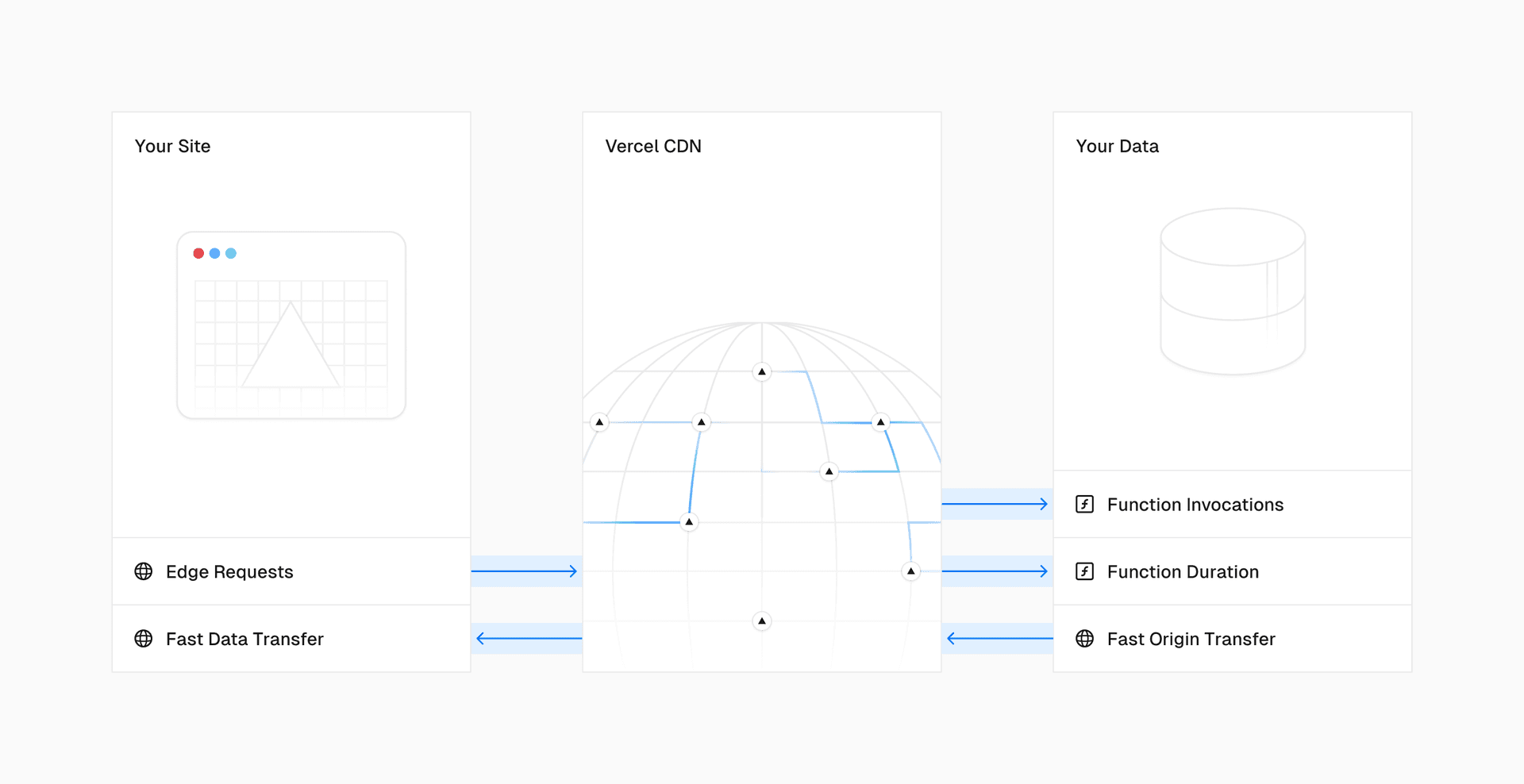
CDN pricing covers three resources:
- Fast Data Transfer: Data sent between the CDN and the visitor's device.
- Fast Origin Transfer: Data sent between the CDN and Vercel Functions.
- CDN Requests: Requests the CDN processes.
An overview of how items relate to the CDN
Select a Region
Fast Data Transfer usage incurs alongside CDN Requests every time a user visits your site, and is priced regionally.
Pro Included
When a user visits your site, the data transfer between Vercel's CDN and the user's device gets measured as Fast Data Transfer. The data transferred gets measured based on data volume transferred, and can include assets such as your homepage, images, and other static files.
Flat Rate CDN
Pro plans charge for CDN usage per unit, and pricing varies by the region where requests originate.
Resource
Hobby Included
First 100 GB
On-demand Rates
$0.15 per 1 GB
The Fast Data Transfer chart on Usage in your dashboard sidebar shows the incoming and outgoing data transfer of your projects.
- The Direction filter allows you to see the data transfer direction (incoming or outgoing)
- The Projects filter allows you to see the data transfer of a specific project
- The Regions filter allows you to see the data transfer of a specific region. This is can be helpful due to the nature of regional pricing and Fast Data Transfer
As with all charts on the Usage section in the sidebar, you can select the caret icon to view the chart as a full page.
To optimize Fast Data Transfer, you must optimize the assets that are being transferred. You can do this by:
- Using Vercel's Image Optimization: Image Optimization on Vercel uses advanced compression and modern file formats to reduce image and video file sizes. This decreases page load times and reduces Fast Data Transfer costs by serving optimized media tailored to the requesting device
- Analyzing your bundles: See your preferred frameworks documentation for guidance on how to analyze and reduce the size of your bundles. For Next.js, see the Bundle Analyzer guide
To further analyze the data transfer of your projects, you can use Observability in the sidebar.
Calculating Fast Data Transfer
Fast Data Transfer is calculated based on the full size of each HTTP request and response transmitted to or from Vercel's CDN. This includes the body, all headers, the full URL and any compression. Incoming data transfer corresponds to the request, and outgoing corresponds to the response.
Fast Origin Transfer
Fast Origin Transfer is incurred when using several Vercel products including Vercel Functions, Middleware, Blob and Data Cache (used through ISR).
Resource
Hobby Included
Pro Included
On-demand Rates
First 10 GB
Usage-based
$0.06 per 1 GB
- Incoming: The number of bytes sent as part of the
HTTP Request (Headers & Body).
- For common GET requests, the incoming bytes are normally inconsequential (less than 1KB for a normal request).
- For POST requests, like a file upload API, the incoming bytes would include the entire uploaded file.
- Outgoing: The number of bytes sent as the HTTP Response (Headers & Body).
Optimizing Fast Origin Transfer

If using Vercel Functions, you can optimize Fast Origin Transfer by reducing the size of the response. Ensure your Function is only responding with relevant data (no extraneous API fields).
You can also add caching headers to the function response. By caching the response, future requests serve from the CDN cache, rather than invoking the function again. This reduces Fast Origin Transfer usage and improves performance.
Ensure your Function supports If-Modified-Since or Etag to prevent duplicate data transmission ( on by default for Next.js applications).
If using Middleware, it is possible to accrue Fast Origin Transfer twice for a single Function request. To prevent this, you want to only run Middleware when necessary. For example, Next.js allows you to set a matcher to restrict what requests run Middleware.
CDN Requests
- Look at the Fast Origin Transfer section of the Usage page:
- Observe incoming vs outgoing usage. Reference the list above for optimization tips.
- Observe the breakdown by project.
- Observe the breakdown by region (Fast Origin Transfer is priced regionally)
- If optimizing Outgoing Fast Origin Transfer:
- Observe the breakdown by project to identify which projects contribute most
- Filter by invocations to see which specific compute is being accessed most
When visiting your site, requests are made to a Vercel CDN region. Traffic is routed to the nearest region to the visitor. Static assets and functions all incur CDN Requests.
Select a Region
Hobby Included
Resource
Pro Included
First 1,000,000
On-demand Rates
$2.00 per 1,000,000 Requests
Edge Request CPU Duration
You can view the Edge Requests chart on Usage in your dashboard sidebar. This chart shows:
N/A
1 Hour
$0.30 per 1 Hour
- Count: The total count of requests made to your deployments
- Projects: The projects that received the requests
- Region: The region where the requests are made
As with all charts on the Usage section in the sidebar, you can select the caret icon to view the chart in full screen mode.
Frameworks such as Next.js, SvelteKit, Nuxt, and others help build applications that automatically reduce unnecessary requests.
The most significant opportunities for optimizing CDN Requests include:
- Identifying frequent re-mounting: If your application involves rendering a large number of images and re-mounts them, it can inadvertently increase requests
To identify: Use your browsers devtools and browse your site. Pay attention to responses with a
304 status code
on repeated requests paths. This indicates content that has been fetched multiple times
- Excessive polling or data fetching: Applications that poll APIs for live updates, or use tools like SWR or React Query to reload data on user focus can contribute to increased requests
Edge Request CPU duration
Edge Request CPU duration is the measurement of CPU processing time per CDN Request. CDN Requests of 10ms or less in duration don't incur any additional charges. CPU duration is metered in increments of 10ms.
Managing Edge Request CPU duration
View the Edge Request CPU Duration chart on Usage in your dashboard sidebar. If you notice an increase in CPU duration, investigate the following aspects of your application:
- Number of routes.
- Number of redirects.
- Complex regular expressions in routing.
To investigate further:
- Identify the deployment where the metric increased.
- Compare rewrites, redirects, and pages to the previous deployment.
Flat Rate CDN
Last updated September 14, 2026
Cross-link map: CDN pricing and usage (/docs/manage-cdn-usage)From the Vercel docs graph (built 2026-09-21T05:26:59.511Z), spanning vercel.com docs + KB, nextjs.org, ai-sdk.dev, and other Vercel documentation sites. Full graph as JSON: https://vercel.com/docs/graph.jsonSemantically closest pagesVercel CDN overview — Vercel's CDN is a globally distributed platform that handles routing, caching, security, and compression for every deploFlat Rate CDN — Flat Rate CDN gives you fixed monthly CDN pricing and protection against usage spikes across capacity tiers.Manage and optimize usage — Understand how to manage and optimize your usage on Vercel, learn how to track your usage, set up alerts, and optimize yPricing on Vercel — Learn about Vercel's pricing model, including the resources and services that are billed, and how they are priced.How Vercel CDN works — Learn how Vercel's CDN processes requests through routing, caching, and compute layers to deliver your content with lowThis page links to (12)generateEtags — Next.js will generate etags for every page by default. Learn more about how to disable etag generation here.proxy.js — API reference for the proxy.js file.Optimizing package bundling — Learn how to analyze and optimize your application's server and client bundles with the Next.js Bundle Analyzer for TurbVercel CDN Cache — Learn how Vercel's CDN cache stores your content across a global network to reduce latency and origin load.Vercel CDN overview — Vercel's CDN is a globally distributed platform that handles routing, caching, security, and compression for every deploNext.js on Vercel — Vercel is the native Next.js platform, designed to enhance the Next.js experience.Nuxt on Vercel — Deploy Nuxt applications to Vercel and configure rendering, functions, middleware, routing, image optimization, and cachSvelteKit on Vercel — Deploy SvelteKit applications to Vercel and configure the adapter, rendering, streaming, ISR, analytics, and Routing MidImage Optimization with Vercel — Transform and optimize images to improve page load performance.Pricing on Vercel — Learn about Vercel's pricing model, including the resources and services that are billed, and how they are priced.Flat Rate CDN — Flat Rate CDN gives you fixed monthly CDN pricing and protection against usage spikes across capacity tiers.Regional Pricing — Vercel pricing for Managed Infrastructure resources in different regions.Pages that link here (45)By site: vercel-changelog (2) · vercel-kb (2) · vercel-docs (41)From vercel-changelogFlat Rate CDN is now GA for Pro teamsVercel Blob now supports consistent reads on private storageFrom vercel-kbPenetration testing on Vercel — Learn how to perform pentesting on Vercel.How to reduce Vercel Image Optimization costs — Learn how to reduce Vercel Image Optimization costs in Next.js by tuning cache TTLs, image sizes, formats, and quality.From vercel-docsAlerts — Get notified when something's wrong with your Vercel projects. Set up alerts through Slack, webhooks, or email so you caCache-Control headers — Learn about the cache-control headers sent to each Vercel deployment and how to use them to control the caching behaviorVercel CDN overview — Vercel's CDN is a globally distributed platform that handles routing, caching, security, and compression for every deploLegacy Usage & Pricing for Functions — Learn about legacy usage and pricing for Vercel Functions.WebSockets — Serve WebSocket connections in Vercel Functions for realtime features like chat, collaboration, and AI streaming.Image Optimization with Vercel — Transform and optimize images to improve page load performance.Legacy Pricing for Image Optimization — This page outlines information on the pricing and limits for the source images-based legacy option.Limits and Pricing for Image Optimization — This page outlines information on the limits that are applicable when using Image Optimization, and the costs they can iIncremental Static Regeneration \(ISR\) — ISR serves cached static pages while regenerating content in the background. Vercel\\Observability Insights — List of available data sources that you can view and monitor with Observability on Vercel.Partial Prerendering \(PPR\) — Partial Prerendering serves a cached static shell instantly, then renders and streams the dynamic parts of a page per rePricing on Vercel — Learn about Vercel's pricing model, including the resources and services that are billed, and how they are priced.Flat Rate CDN — Flat Rate CDN gives you fixed monthly CDN pricing and protection against usage spikes across capacity tiers.Calculating usage of resources — Understand how Vercel measures and calculates your resource usage based on a typical user journey.Stockholm, Sweden \(arn1\) pricing — Vercel pricing for the Stockholm, Sweden \(arn1\) region.Mumbai, India \(bom1\) pricing — Vercel pricing for the Mumbai, India \(bom1\) region.Paris, France \(cdg1\) pricing — Vercel pricing for the Paris, France \(cdg1\) region.Cleveland, USA \(cle1\) pricing — Vercel pricing for the Cleveland, USA \(cle1\) region.Cape Town, South Africa \(cpt1\) pricing — Vercel pricing for the Cape Town, South Africa \(cpt1\) region.Dublin, Ireland \(dub1\) pricing — Vercel pricing for the Dublin, Ireland \(dub1\) region.Frankfurt, Germany \(fra1\) pricing — Vercel pricing for the Frankfurt, Germany \(fra1\) region.São Paulo, Brazil \(gru1\) pricing — Vercel pricing for the São Paulo, Brazil \(gru1\) region.Hong Kong \(hkg1\) pricing — Vercel pricing for the Hong Kong \(hkg1\) region.Tokyo, Japan \(hnd1\) pricing — Vercel pricing for the Tokyo, Japan \(hnd1\) region.Washington D.C., USA \(iad1\) pricing — Vercel pricing for the Washington D.C., USA \(iad1\) region.Seoul, South Korea \(icn1\) pricing — Vercel pricing for the Seoul, South Korea \(icn1\) region.Osaka, Japan \(kix1\) pricing — Vercel pricing for the Osaka, Japan \(kix1\) region.London, UK \(lhr1\) pricing — Vercel pricing for the London, UK \(lhr1\) region.Portland, USA \(pdx1\) pricing — Vercel pricing for the Portland, USA \(pdx1\) region.San Francisco, USA \(sfo1\) pricing — Vercel pricing for the San Francisco, USA \(sfo1\) region.Singapore \(sin1\) pricing — Vercel pricing for the Singapore \(sin1\) region.Sydney, Australia \(syd1\) pricing — Vercel pricing for the Sydney, Australia \(syd1\) region.Montréal, Canada \(yul1\) pricing — Vercel pricing for the Montréal, Canada \(yul1\) region.Monitoring Reference — This reference covers the clauses, fields, and variables used to create a Monitoring query.Vercel Blob — Vercel Blob is a scalable, cost-effective object storage service with private and public access modes for files up to 5Private Storage — Learn how to use private Vercel Blob storage to serve files with authenticationPublic Storage — Learn how to use public Vercel Blob storage to serve files accessible to anyone with the URLVercel Blob Pricing — Learn about the pricing for Vercel Blob.@vercel/blob — Learn how to use the Vercel Blob SDK to access your blob store from your apps.Firewall concepts — Understand the fundamentals behind the Vercel Firewall.Usage & Pricing for Vercel WAF — Learn how the Vercel WAF can affect your usage and how specific features are priced.
You enable it from your team's Billing page. For the steps, see Enable and configure Flat Rate CDN.
Can you trust our partners?
Previous
Flat Rate CDN replaces the per-unit charges on this page with a fixed monthly price for a capacity tier that covers your content delivery.
Custom Error Pages
Was this helpful?


